

When a mother or father dies, the house is suddenly full of decisions. There are guns in the safe, tools in the garage, a truck or trailer out back, furniture that has been in the family for decades, collections nobody else understood, and rooms of ordinary everyday things. Somewhere in the first weeks someone asks: do we need to get all of this appraised? The honest answer is: not always. Here is how to tell.
When you usually need an appraisal. A written appraisal earns its cost when the family has to agree on what things were worth, or prove it to someone else. The common situations: siblings are dividing things unevenly (one keeps the gun collection, another takes cash), or one heir wants to buy out the others. The executor or the probate court asks for an inventory with values. The estate is large enough that an attorney or tax adviser wants documented values. You plan to sell items of real value and want a starting point (inherited property generally takes its date-of-death value as the heirs’ basis — your tax adviser can tell you how that applies to you). Or you are donating items, and the IRS requires a qualified appraisal when a donation of similar items is worth more than $5,000.
When you probably do not. If everything is going to one person, nobody disagrees, nothing is being sold or donated, and the belongings are ordinary household goods, an appraisal may not add anything. If you are unsure, ask. Part of a good appraiser’s job is telling you when you do not need one, and NextPhase will say so.
What to do first. Do not rush to clear the house. Before anything is sold, donated, thrown away, or taken home by a relative, walk through and photograph every room, then open the closets, cabinets, garage, shop and safe and photograph what is inside. Set aside anything that looks valuable. Gather paperwork: receipts, titles, gun records, insurance schedules, and any notes your parent kept about their collections. If an executor or personal representative has been named, they decide when things move. Early, informal “you take this, I’ll take that” is where most family disputes start.
What gets appraised. Most estates have a mix: firearms, hand and power tools, shop machinery, vehicles, trailers and tractors, furniture and antiques, sports cards and memorabilia, musical instruments, collectibles, and the general household contents. Items of significant value are listed one by one; ordinary household goods are usually valued by room or category, which keeps the cost reasonable.
It can be done remotely, even months later. You do not need an appraiser walking through the house while you grieve. Clear photos, serial numbers, maker’s marks and a short description are usually enough, anywhere in the United States. The value is stated as of the date of death even if the appraisal is done weeks or months afterward, as long as the items are still documented. Our photo checklist shows what to capture. An on-site visit is only suggested when the volume or condition makes photos impractical, and you will hear that before you commit to anything.
What it costs and how long it takes. You get a fixed written quote first, usually the same day, so you know the price before any work begins. Small jobs start at $75. Personal property reports are usually delivered in about 48 hours once the photos and information are in, and the quote states the outside limit. The fee never depends on the values reached.
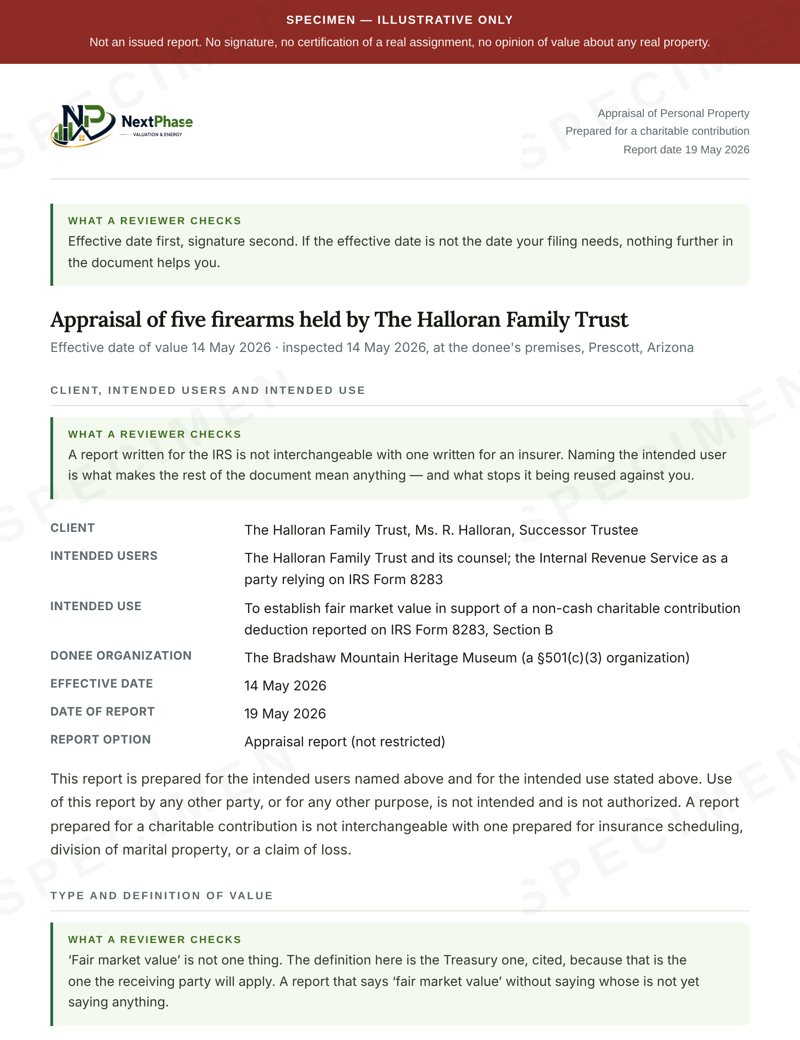
What you receive. A written report that names the date of death as the effective date, states who it is for and why, lists the items and their values, and explains how the values were reached, prepared by an AQB Certified USPAP Instructor under the Uniform Standards of Professional Appraisal Practice. It gives the family, the executor, and the attorney one set of numbers everyone can work from.
Next step. Tell us what your parent left and why you need the values (dividing among heirs, probate, a sale, or a donation). A few photos help but are not required to get a quote. Get a fixed written quote, or read more about valuing household contents for an estate.

 Retrospective and date-of-death valuations
 Gun collection appraisal online: how a remote appraisal works